The Dataset That Didn’t Exist - Until Now
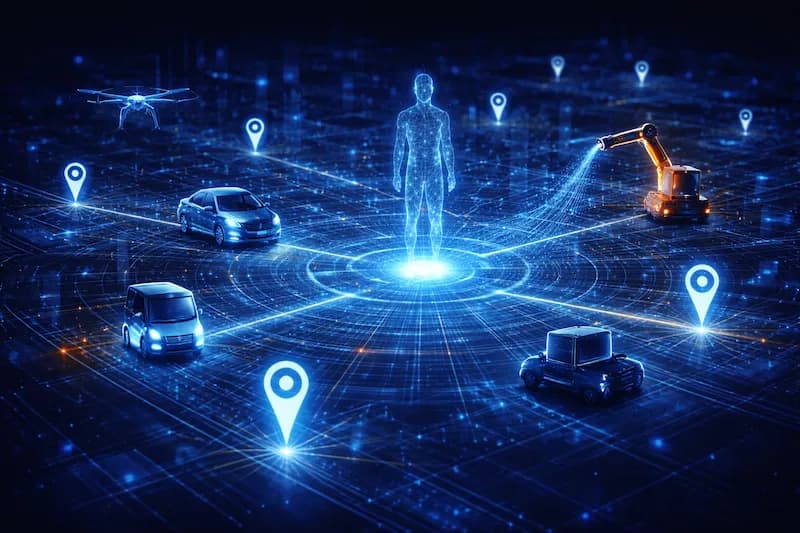
AI has been trained on text, images, code, video, and audio. Trillions of tokens. Billions of data points. Every scrap of human language ever digitized. But there's one dataset that the physical world needs and that has never been built: a continuous, real-time spatial record of where things are.
Not snapshots. Not periodic GPS pings. Not camera frames stitched together with interpolation. A live, always-on feed of position - accurate to the sub-meter, synchronized across every object in a space, updating constantly.
This dataset doesn't exist because no technology has been able to consolidate and centralize this type of information affordably, continuously, in a time-synced way and at scale. GPS doesn't work indoors. Cameras require line of sight and massive compute. Ultra-wideband beacons cost thousands per facility and break when you rearrange the furniture. Every approach is disconnected from every other, and each has its own challenges, trading accuracy for coverage, or coverage for cost, or cost for power consumption.
The result is a gap at the center of Physical AI. We can build machines that see, hear, and reason. But we cannot give them a reliable, efficient sense of where they are - or where anything else is - in real time. That's why autonomous systems still struggle to coordinate in dynamic environments. It's why robots work well in cages and poorly in the open world.
Closing that gap requires something the industry has never had: a way to generate continuous spatial data using infrastructure that's already deployed, without draining the devices being located. It requires turning the wireless network itself into a sensing system.
That's what ZaiNar has built. And the implications go beyond a better version of GPS - they extend to a kind of data that AI has never had access to, and that Physical AI cannot work without.
Follow what happens next
ZaiNar just emerged from nine years of stealth.
Subscribe for updates on Physical AI and the spatial infrastructure layer.